Struggling with the high costs in your custom metal casting1 projects? As a factory owner with over 30 years in this business, I've seen how unexpected expenses2 can eat into profits and make it hard to stay competitive.
The most effective way to reduce costs is by optimizing your part design for manufacturability, choosing the right casting process and material for your volume, and minimizing secondary operations. A strategic partnership with an experienced foundry is the key to making these decisions early and avoiding expensive mistakes.
It sounds simple, but the real savings are buried in the details. Many buyers focus only on the unit price and miss the bigger picture. This leads to costly problems down the line. Let's break down how you can truly save money on your next project. This isn't just theory; this is practical advice from decades on the factory floor, helping clients launch successful products.
What Are the Top 5 Cost Drivers in Custom Metal Casting Manufacturing?
Are you wondering where your budget is actually going? Hidden costs1 in tooling, materials, and labor can blindside even the most experienced buyers, turning a profitable project into a financial headache2.
The biggest costs in metal casting are raw materials, tooling (the mold), labor, energy, and post-processing. According to industry analysis from sources like the American Foundry Society (AFS), these five areas consistently represent the bulk of expenses. Focusing on them gives you the best chance to find significant savings.
Let's dive deeper into each of these. Understanding them is the first step to controlling them. I remember a client, Kevin from the U.S., who was developing a new housing for Siemens electronic parts. He was shocked by the initial quote. We walked him through this cost breakdown, showing him exactly where the money was going. Together, we found ways to optimize each area, bringing the project well within his budget. This transparency is crucial for a successful partnership.
Breaking Down the Primary Costs
| Cost Driver | Description & Impact on Price | How an Experienced Partner Helps You Save |
|---|---|---|
| Raw Material | Often the largest single expense. The cost of alloys like aluminum, zinc, or steel fluctuates with the market. | We advise on cost-effective material alternatives that meet your specifications (e.g., ASTM standards) and buy in bulk to secure better pricing. |
| Tooling | A significant one-time, upfront cost for the mold. Complex designs require more expensive tooling1. | We help optimize your design for simpler, more durable tooling1. For high volumes, the per-unit amortization cost drops significantly. |
| Labor & Energy | The wages for skilled operators and the power to melt metal. These are major operational costs. | Our refined management and modern, energy-efficient equipment on our 10 production lines help keep these costs predictable and low. |
| Post-Processing | Secondary work like CNC machining2 or surface finishing. The more finishing, the higher the cost. | We design parts to be as "net-shape" as possible right out of the mold, reducing the need for costly secondary machine time. Find out more about our CNC Machining services. |
How Can Smart Design Reduce Casting Defects and Material Waste?
Are casting defects like cracks or porosity driving up your costs? From a buyer's perspective, receiving a pallet of bad parts is a nightmare that can shut down your production line and cause major project delays.
Simplify your design by maintaining uniform wall thickness, using generous radii instead of sharp corners, and adding draft angles. These core Design for Manufacturability (DFM) principles prevent the most common defects and save enormous material and rework costs.
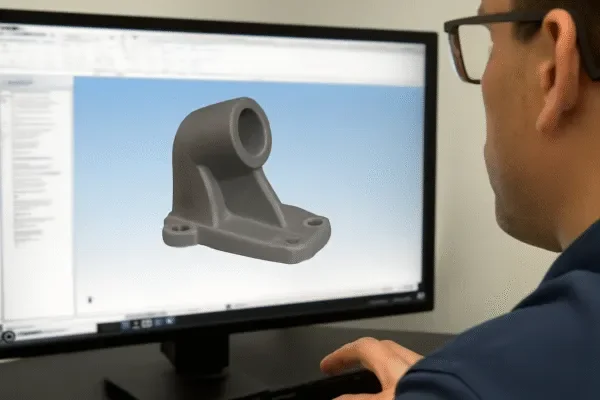
Thinking about manufacturing from day one is the most critical step. Porosity, for example, is often caused by non-uniform wall thickness. The thick sections cool much slower than the thin sections, and as the metal solidifies and shrinks, it can pull away, creating voids. By balancing the wall thickness, we allow the part to cool evenly, creating a dense, strong product. This simple change, often identified in our DFM review, avoids a major quality issue before a single piece of steel is cut for the mold.
From Problematic to Profitable Design
| Problematic Design Feature | Why It's Costly (The Technical Reason) | Optimized Design Solution |
|---|---|---|
| Sharp Internal Corners | Creates stress concentration points during cooling, a common failure point for cracks. | Add a generous radius (fillet) to distribute stress and improve molten metal flow. |
| Varying Wall Thickness | Causes differential cooling rates, leading to shrinkage porosity and internal stress that can warp the part. | Design walls to be as uniform in thickness as possible for controlled solidification. |
| No Draft Angle | The part's vertical surfaces scrape against the mold during ejection, causing surface defects and slowing cycle times. | Add a small taper (~1-3 degrees) to all vertical faces for easy release. |
| Unnecessary Complexity | Requires more complex (and expensive) tooling with slides or cores; increases the chance of casting defects. | Simplify the geometry. Ask if a feature can be machined later more cheaply. We help you make this trade-off analysis. |
How Does Choosing the Right Casting Process Optimize Cost?
With so many casting methods available, how do you know which one is right for your project? I've seen companies spend a fortune on die cast tooling for a product that only needed a few thousand units. This is a costly mistake.
For low volumes, sand casting is often best due to its cheap tooling. For high-volume parts, die casting is more cost-effective despite high initial tooling costs. The right choice is a balance between your quantity, material, complexity, and budget. Explore our full range of custom metal casting services to see what's possible.
The key is to match the process to your specific needs. The first decision we make with a new customer is selecting the manufacturing method. This impacts every other cost. If your quantity is high, investing more in the tooling for an automated process like die casting will pay for itself many times over with a lower unit cost. Long-term partnerships allow us to really dial in the process for maximum efficiency and cost reduction over the product's life.
Comparing Common Casting Methods
| Feature | Sand Casting | Investment Casting | Die Casting |
|---|---|---|---|
| Best for Volume | Low to Medium (1-1,000s) | Low to Medium (10s-10,000s) | High (5,000s to millions) |
| Tooling Cost | Low | Medium | High |
| Unit Price | High | High | Low |
| Complexity & Finish | Simple, large parts; Rough finish | Very complex shapes; Excellent finish | Complex, high precision; Good finish |
| Material Choice | Very Wide (most metals) | Very Wide | Limited (mostly non-ferrous) |
Why Does Material Selection Heavily Impact Your Final Cost?
Are you choosing your material based only on its performance characteristics? The price of the raw metal is a huge part of your final cost, and an expensive alloy can inflate your budget unnecessarily when a more cost-effective option would work just as well.
Selecting the right material involves balancing performance, weight, and price. For example, zinc alloys are often cheaper and easier to cast than aluminum, potentially lowering both material and production costs if specific strength-to-weight ratios are not required.
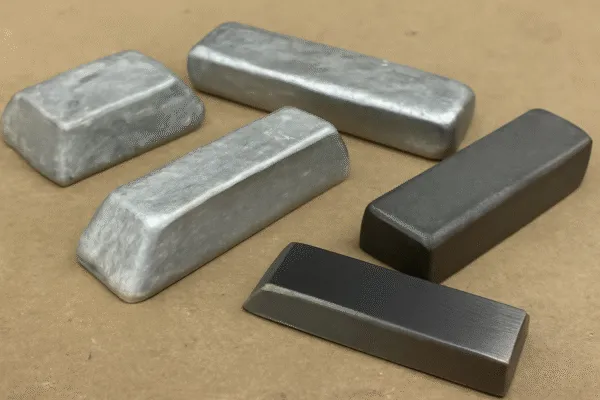
Don't get locked into a specific material before talking to your foundry partner. I had a client from Europe who insisted on a specific grade of stainless steel for a non-critical component. After we discussed its application, we suggested a different grade that still exceeded all performance needs per the relevant ASTM International standards, but was much easier for us to source and cast. This simple switch saved them nearly 30% on raw material costs for a very large order.
Common Materials: Cost vs. Properties
| Material (ASTM examples) | Relative Cost | Key Properties | Common Applications |
|---|---|---|---|
| Zinc Alloys (ASTM B86) | Low | Easy to cast, excellent detail, good finish | Hardware, decorative parts, automotive |
| Aluminum Alloys (A380) | Medium | Lightweight, corrosion resistant, high thermal conductivity | Electronics, automotive, consumer goods |
| Carbon Steel (A27) | Medium | Strong, tough, versatile | Industrial machinery, structural components |
| Stainless Steel (A743) | High | Excellent corrosion resistance, strong, aesthetic appeal | Food-grade equipment, marine hardware |
How Does a Partnership with an Experienced Foundry Save You Money?
Are frequent communication issues or quality problems with your supplier costing you more than just money? These hidden costs from delays and defects can damage your reputation and destroy any initial price advantage.
An experienced foundry is a manufacturing partner. We provide critical design feedback and follow rigorous quality protocols like PPAP (Production Part Approval Process) to ensure your parts are perfect from the first shot. This proactive approach saves you significant money in the long term.
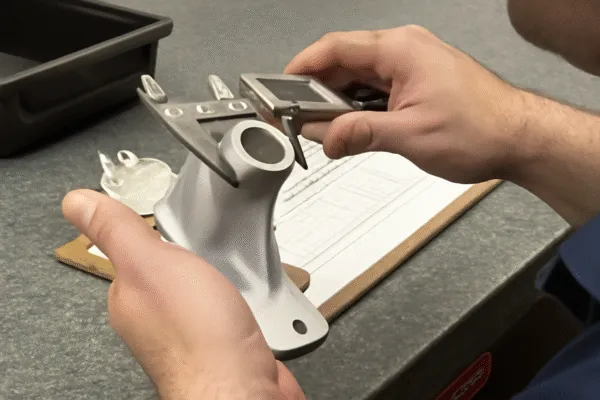
True cost savings come from a smooth, predictable supply chain. Our ISO 9001:2015 certification isn't just a document on the wall; it’s the framework for everything we do. For a new part, this means a detailed PPAP submission with dimensional reports, material certifications, and process flow charts. It gives you the confidence that the part we designed with you is the exact part you will receive in every shipment, whether it’s the first or the millionth. This eliminates risk for you.
The Value Beyond the Price Tag
- Proactive DFM Support: We review your designs before we make the tool. Our engineers find ways to make your part stronger, lighter, and cheaper to produce.
- Guaranteed Quality: Our ISO 9001 system and PPAP process ensure a controlled and repeatable manufacturing line. We catch potential issues before parts ever leave our factory.
- Reliable Logistics: We've shipped products all over the world for decades. We know how to manage customs, packaging, and shipping to ensure your parts arrive safely and on time.
FAQs About Reducing Casting Costs
How does production quantity affect the cost of custom casting? Quantity has a huge impact. The high upfront tooling cost gets spread over more parts, so the per-unit cost drops dramatically with larger orders. For 1,000 parts, a $10,000 tool adds $10 per part. For 100,000 parts, it's only $0.10.
Can you use my 3D model to create a casting? Yes, a 3D CAD model (like a STEP or IGS file) is the standard starting point. We use it to design the mold and run solidification simulations to ensure a successful casting process before cutting any steel.
How much does tooling for a custom metal part usually cost? It varies widely. A simple sand-casting pattern might be a few hundred dollars. A complex, multi-cavity hardened steel die for die casting can cost tens of thousands. We provide a detailed and transparent tooling quote upfront.
What is the typical lead time for a custom casting project? It has two parts: tooling and production. Tooling can take 4-8 weeks. Once the tool is approved (often after a PPAP submission), mass production is much faster. We provide a detailed project timeline with every quote.
Conclusion
To truly reduce casting costs, you must look beyond the unit price. Focus on smart design, select the right process and material, and partner with a foundry that invests in your success.
Ready to Start Your Project?
Let our experience save you time and money.