
Scrap piles grow. Deadlines slip. Fatigue cracks appear where no one expects. I stop the waste. I choose the process on facts, not habit. If you need quick orientation while you read, compare our routes on Metal Forgings and CNC Parts; both sit inside the controls we run on Quality Control and the overview on Prime.

I use a simple rule. Choose forging when buy-to-fly matters, when fatigue or impact risk is real, and when volume can cover dies. Choose CNC when speed, design churn, deep pockets, or very tight tolerances lead. I also plan the switch point so a program can start fast in CNC and move to near-net forging once the drawing freezes.
Material Utilization & Scrap Rate Comparison?
I start with one question: what percent of the metal I buy stays in the part? That number drives cost, lead time, and freight. The inverse is buy-to-fly (BTF). For shared context on BTF and material efficiency, I point teams to Aerospace Corporation on buy-to-fly. Near-net forging pushes BTF down. Heavy hog-outs push it up.
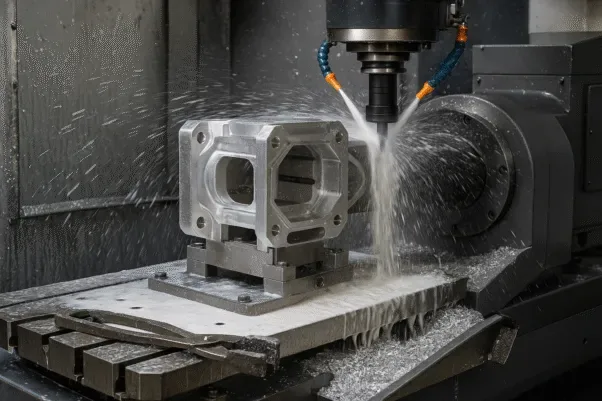
Utilization snapshots I see on quotes
| Scenario | Finished | Starting | Util. | BTF |
|---|---|---|---|---|
| Plate hog-out (7075 bracket) | 2.0 kg | 10.0 kg | 20% | 5.0 |
| Closed-die near-net forging | 2.0 kg | 2.8 kg | 71% | 1.4 |
| Ring-rolled flange | 8.0 kg | 9.0 kg | 89% | 1.12 |
Material–process pairing I actually run
| Alloy | Typical form | Forging friendly | CNC friendly | Shop notes |
|---|---|---|---|---|
| 6061-T6 Al | Plate, extrusion | Yes | Yes | Prototype workhorse; lower strength |
| 7075-T73/T74 | Forging stock, plate | Yes | Yes | T73/T74 favored for SCC margin |
| 7050-T7451 | Forging stock, plate | Yes | Yes | Better toughness in thick sections |
| Ti-6Al-4V | Billet, forging stock | Yes | Yes | Forging helps fatigue; slow to cut |
| 15-5 PH / forging stock, bar | Forging stock, bar | Yes | Yes | Stable through heat treat |
| 4340/300M | Forging stock | Yes | OK | Flow at bores helps HCF life |
| Inconel 718 | Ring, forging stock | Yes | Hard | Ring rolling lifts utilization |
Cost drivers that swing BTF decisions
| Driver | Effect on CNC hog-outs | Effect on forgings |
|---|---|---|
| Geometry (deep pockets) | Large chip volume, low utilization | Near-net aids pocket depth |
| Stock allowance | More removal minutes | Less removal if die fit is good |
| Nesting/yield | Plate layout drives 10–20% spread | Preforms less layout-sensitive |
| Scrap value | Chips pay pennies | Lower chip revenue (less scrap) |
| Freight | Heavier blanks cost more | Near-net reduces freight mass |
I keep the conversion gate visible from day one. If a program must start fast in CNC, I write the step to switch to near-net forging once design stabilizes. For internal proof points, I share one-page snapshots under Case Studies.
Mechanical Properties (Grain Flow vs Machined Fibers)?
Parts fail where fibers get cut. I look at load path and notch risk on day one. Forging steers grain flow around fillets and bores. That lifts fatigue and impact strength at real hotspots. Machining from rolled plate cuts fibers at edges and pocket floors. That raises notch sensitivity. I document surface control so the benefit sticks.
What I do on safety-critical parts
| Topic | My action | Why it matters |
|---|---|---|
| Grain flow vs load path | Align parting, draft, and lugs to loads | Cuts notch effect at bores/fillets |
| Fillet transitions | Enlarge and polish critical fillets | Delays crack start |
| Bores in tension | Roll or burnish after finish | Adds compressive layer in hoop |
| Shot peening | Set intensity/coverage by spec | Lifts fatigue if controlled |
| Records | Keep Almen strips and photos in lot | Traceable benefit, audit-ready |
Standards and accreditation I follow
| Item | Source page (official) | Use |
|---|---|---|
| Quality system | ISO 9001:2015 | QMS baseline |
| Special processes | Nadcap special processes | HT, NDT, coatings |
| Peening intensity method | SAE J443 peening intensity | Intensity, coverage |
Tooling & Setup Costs vs Machining Minutes?
Dies look scary. Minutes look cheap. That is a trap. Dies add a fixed cost. Machining minutes add a variable cost. When volume rises, the slope beats the intercept. A hog-out at 150 minutes vs a near-net forging at 35 minutes, at $75/hour, is $187.50 vs $43.75 of machine time. The savings pay back a $60,000 die in a few hundred parts. I also count the extra material cost from high BTF on hog-outs.

Payback math I actually use
Die cost (Td) = 60,000; minutes saved = (150–35) = 115 = 1.9167 hr
Rate (R) = $75/hr; savings/part = 1.9167 × 75 ≈ $143.75
Break-even volume V = Td / savings ≈ 60,000 / 143.75 ≈ 418 pcs
Note: lower BTF on forgings brings extra material savings.
Observed ranges by part type
| Part type | Hog-out min | Forged min | Die cost | Break-even |
|---|---|---|---|---|
| Aerospace bracket | 120–240 | 25–60 | 30k–120k | 250–900 |
| Automotive steering knuckle | 80–150 | 20–50 | 40k–150k | 300–1,000 |
| Rail coupler parts | 60–120 | 15–45 | 50k–150k | 300–800 |
| General lever/arm | 60–180 | 20–60 | 10k–60k | 150–700 |
Sensitivity table for decision speed
| Change | Direction | Impact on break-even | What I adjust |
|---|---|---|---|
| Shop rate +$10/hr | ↑ | Faster payback | Pull conversion gate earlier |
| Minutes saved +20 | ↑ | Faster payback | Reduce forging stock; tune ops |
| Die cost +$20k | ↑ | Later payback | Add multi-cavity; refine scope |
| Material +$2/kg on hog-outs | ↑ | Faster payback | Emphasize BTF delta; resize blanks |
Typical Applications (Aerospace, Automotive, Rail)?
Industries choose by physics and risk. Aerospace brackets and landing-gear lugs favor forgings for BTF and fatigue life. Automotive crankshafts and knuckles are textbook forgings because of impact and volume. Rail couplers prefer forgings for shock and cold service. CNC still finishes interfaces or carries prototypes until drawings freeze. When your BOM also has castings or stampings, I align those routes under Casting Parts and Stamping Parts so the full pack behaves like one plan.
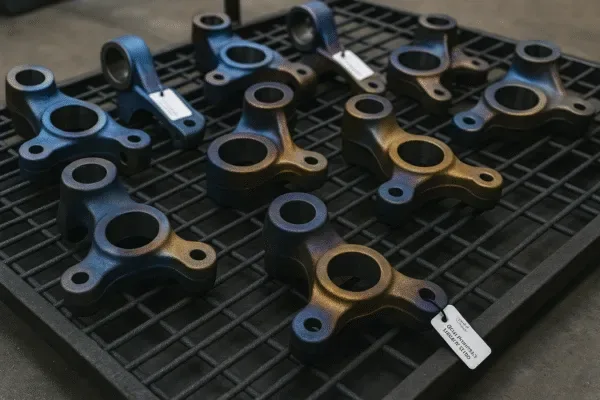
Selection snapshot you can take to a line review
| Industry | Part | Load case | Best default | When I switch |
|---|---|---|---|---|
| Aerospace | Bracket, lug, link | Fatigue + weight | Forging | Rapid redesign → CNC for speed |
| Automotive | Knuckle, rod | Impact + fatigue | Forging | Very small run → CNC for agility |
| Rail | Coupler components | Shock + low temp | Forging | Tooling not ready → CNC short run |
| Avionics | Pocketed tray | Stiffness + pockets | CNC | Stable + volume → near-net forging |
Process Maps You Can Use Right Now
Closed-Die Forging + CNC Finish (the route I run most)
| Step | Owner | Key checks | Typical time |
|---|---|---|---|
| 1 | Design/QE | Flow map, parting line, radii, draft | 1–3 days |
| 2 | Tooling | Ejectors, flash, die steel, hardening | 3–5 days |
| 3 | Tool room | EDM finish, gauge tooling | 2–4 weeks |
| 4 | Forge | Fill, laps, flash, dimensions | 1–3 days |
| 5 | Heat treat | Hardness, distortion plan | 2–5 days |
| 6 | CNC rough | Stock, datums, probing | 1–3 days |
| 7 | CNC finish | Bores, threads, GD&T features | 1–4 days |
| 8 | Surface | Intensity/coverage records (J443) | 1–2 days |
| 9 | QC | FAIR/PPAP, CMM, NDT | 1–3 days |
| 10 | Pack | Spec, labels, MTR | 1 day |
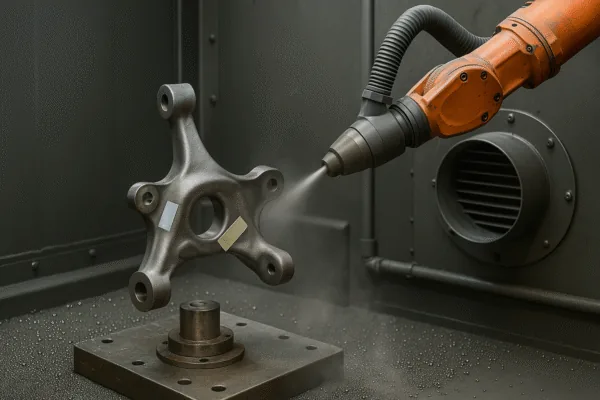
CNC Hog-Out from Plate/Bar (fast-track when designs churn)
| Step | Owner | Key checks | Typical time |
|---|---|---|---|
| 1 | CAM | Tool reach, chatter, tool life | 1–3 days |
| 2 | Saw | Yield, grain direction | 1–2 days |
| 3 | CNC rough | Warp control, stress relief | 1–4 days |
| 4 | CNC finish | GD&T features, finish | 1–3 days |
| 5 | Heat treat | Distortion plan | 2–5 days |
| 6 | QC | CMM, threads, surface | 1–2 days |
| 7 | Pack | Edge guards, VCI, tray fit | 1 day |
Lead-time drivers I watch
| Driver | Why it slips | What I do |
|---|---|---|
| Die steel/EDM queue | Shared toolroom bottleneck | Lock slot; dual inserts for change |
| Heat treat capacity | Batch windows, quench delay | Reserve window; design for rack |
| CMM program time | Complex GD&T, fixturing | Probe datums; reuse parametric code |
| Sub-tier finishing | Coater/NDT slots | Book early; spec alternates via Surface Treatment |
| Packaging readiness | Late spec/labels | Freeze spec; pull samples early |
Tolerances, Surfaces, and Inspection
I set tolerances with the process, not after it. I build datum strategies that match how metal flows and how parts seat. I log evidence so audits move fast.
Capabilities I hold in steady production
| Feature | CNC (stable setup) | Forging + finish | Notes |
|---|---|---|---|
| Bore Ø20–80 mm | IT7–IT8 (boring) | IT7–IT8 | Hone for bearing fits |
| Flatness 200×200 mm | 0.05–0.10 mm | 0.05–0.10 mm | Datum strategy matters |
| True position on lug hole | 0.05–0.20 mm | 0.05–0.20 mm | Flow helps stock location |
| Surface finish (functional) | Ra 0.8–3.2 μm | Ra 0.8–3.2 μm | Grind/lap when needed |
Design-change risk vs process
| Scenario | CNC route | Forging route |
|---|---|---|
| Many ECOs expected | Strong (no dies) | Weak until die freeze |
| Late tolerance tightening | Manageable | Manageable after stock review |
| Weight reduction after DV | Quick to test | Possible with die revision |
MOQ guidance for planning lots
| Part size/complexity | CNC MOQ | Forging MOQ |
|---|---|---|
| Small bracket (Al) | 10–50 pcs | 200–500 pcs/lot |
| Steel knuckle | 5–20 pcs | 200–600 pcs/lot |
| Large rail coupler component | 1–10 pcs | 50–150 pcs/lot |
Packaging That Survives the Trip
Good parts deserve good packing. I write the pack spec during RFQ and prove it with drop and vibration tests. Steel forgings get VCI + oil + desiccant and reinforced cartons. Aluminum brackets get foam-tray inserts and edge protection. Heavy couplers ride in blocked crates with anti-slip and HT pallets. The method and photos live in the traveler and support claims. If you want the hand-off details after delivery, I keep them summarized under After-Sales Care.
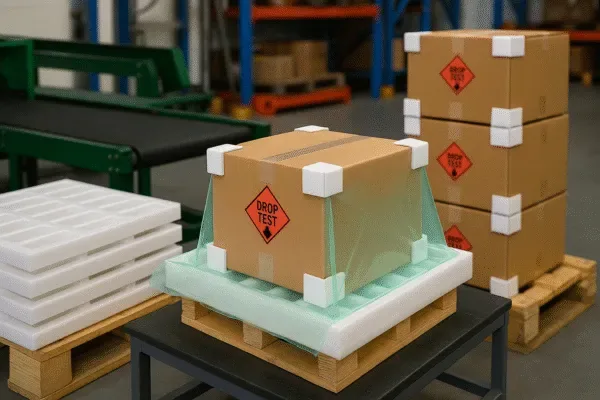
Packaging matrix I apply
| Part type | Inside protection | Outside protection | Labeling |
|---|---|---|---|
| Steel forging | VCI bag + light oil + desiccant | Double-wall carton + corner guards | Part #, heat, lot, PO |
| Al bracket | Foam-insert tray + PE bag | Drop-tested carton + edge caps | Part #, rev, lot |
| Heavy coupler | Blocking + anti-slip + strap | Crate on HT pallet | Stencil + gross weight |
Conversion Plan and Contact
Prototype in CNC when designs churn; convert to near-net forging once drawings freeze and the break-even sits inside your forecast. I publish a two-route cost sheet, a gating plan, and the pack/finish route so your launch is clean. For adjacent components in your BOM, I keep interfaces aligned by routing them on Plastic Parts and finishing choices on Surface Treatment.
Program conversion steps
Step | CNC deliverable | Forging deliverable
| Step | CNC deliverable | Forging deliverable |
|---|---|---|
| 1 | Prototype parts + DFM notes | Die split + stock map |
| 2 | Cycle-time + scrap data | First article forging trial data |
| 3 | Tolerance risk list | Flow lines vs load path review |
| 4 | Finish + pack sample | Peen plan (J443); CMM/UT plan |
| 5 | Costed roll-up (TCO) | Break-even and ramp plan |
FAQs buyers actually ask
Is forging cheaper than CNC for aluminum brackets?
At low volume, CNC can be cheaper because there is no die. At steady volume, forgings win because material waste drops and minutes fall. I share a two-route TCO so finance sees it in one page.
What is buy-to-fly and why does it matter?
BTF is input weight divided by finished weight. Near-net forgings can hit 1.1–1.7. Plate hog-outs can hit 3–8 or higher. Lower BTF cuts cost, minutes, and even freight.
When should I choose open-die vs closed-die forging?
Open-die fits large, simple shapes like shafts and blocks. Closed-die fits shaped parts with lugs, pockets, and fillets and gives better grain flow and utilization.
Which is stronger: forged 7075 vs machined from 7075 plate?
Static strength can be similar. Fatigue and impact near fillets and bores are usually better in forgings due to grain flow. I confirm on CMM and by process evidence in the traveler.
How long do forging dies take, and what do they cost?
Simple dies arrive in weeks; complex dies take longer. Typical costs run $10k–$150k+. I plan the die route with a CNC fallback so your schedule does not stall.
Conclusion
Choose forging when buy-to-fly and fatigue dominate. Choose CNC when speed and design change dominate. I will do the math, flag risks, and set the pack so the first build lands clean. If you are ready to compare the two paths for your part and get a firm break-even with finishing and packaging locked, send your files and notes here → Contact Prime.