Are you worried your overseas supplier might not grasp the specific thread standards you need? As a buyer, you know that a small mix-up on a drawing can lead to huge costs, project delays, and a damaged reputation.
Yes, experienced B2B factories like ours are fluent in American (ASME/ANSI), British (BS), and metric (ISO, DIN, JIS) thread standards. From a buyer's perspective, this means you can trust that our ISO 9001-certified processes1, including PPAP documentation2, guarantee every part meets your exact specifications, preventing expensive errors.
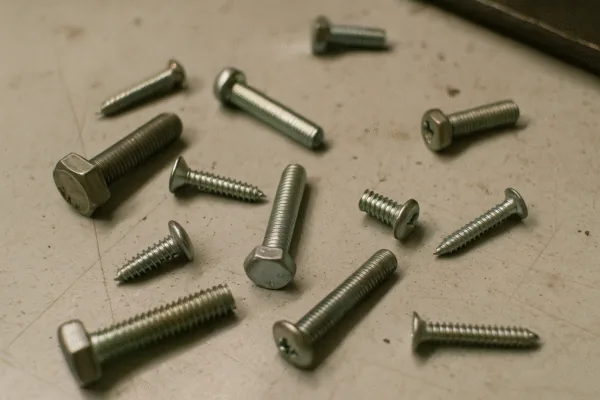
It’s easy for a factory to say they understand global standards, but how can you be certain? After more than 30 years running this factory, I can tell you that true expertise goes far beyond simply recognizing a name. It involves a deep, practical mastery of engineering drawings1 and a commitment to staying current with standard revisions. It means investing continuously in the right tools to verify every dimension. In this article, I'll share the lessons I've learned firsthand to help you, as a buyer, distinguish a truly capable partner from one that just talks a good game.
Can Standard Terminology Create Communication Breakdowns?
You clearly specify "M8 thread" on your order, but what if the factory's interpretation differs slightly from yours? This tiny misunderstanding can result in thousands of useless parts.
Yes, standard language can become a barrier if not managed with absolute precision. We overcome this by treating your engineering drawing as the single source of truth. The drawing specifies every critical detail as defined by standards like ISO 9652 (for metric threads), ensuring we and our clients work from the exact same playbook.
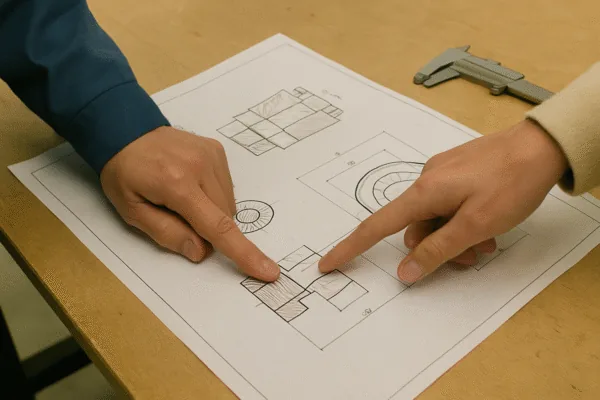
From a buyer’s viewpoint, ambiguity is risk. An incomplete request like "standard 1/4 inch screw" is an immediate red flag for any professional supplier. To us, it requires immediate clarification. Does this require a coarse thread or a fine thread? What is the material specification? This is a conversation we must have to protect your investment. Without it, you are simply hoping for the best.
The Power of the Drawing
We never start production based on an email description alone. The technical drawing1 is king. It removes all guesswork and serves as the binding contract for the part's geometry. For a complex component like our custom stamping parts, the drawing defines:
- Nominal Diameter & Pitch: The primary size and thread spacing (e.g., M8x1.25).
- Class of Fit: The tolerance that dictates how loose or tight the connection will be.
- Geometric Dimensioning and Tolerancing (GD&T): For high-precision parts, GD&T callouts are critical. They control features like the perpendicularity of the head to the thread axis, which is vital in automated assemblies.
Is Your Factory Using the Correct Version of the Standard?
Standards are updated over time. As a buyer, are you confident your supplier is manufacturing to the exact version you need, or are they using an outdated one?
The standard's version is absolutely critical. A professional supplier will always ask you to specify the revision year on your drawings. As part of our Production Part Approval Process (PPAP)2, we document the exact standard used, guaranteeing full traceability and compliance for your records.
Organizations like the American Society of Mechanical Engineers (ASME) and the German Institute for Standardization (DIN) constantly evolve standards. I had a client who came to us after his project failed inspection. His previous supplier used an old DIN standard for a socket screw. The head height had been revised, and the old parts wouldn't sit flush. This is the kind of costly mistake that a rigorous PPAP system prevents.
Our Standard Verification Process
Our ISO 9001 certified process2 ensures this never happens.
| Step | Action | Purpose for the Buyer |
|---|---|---|
| 1. Drawing Review | Our engineering team identifies the standard and revision year. | Ensures your exact requirement is captured (e.g., "ASME B18.2.1-2012"). |
| 2. PPAP Documentation | We create a PPAP file that formally records the standard version. | Provides you with auditable proof that the correct specification was used. |
| 3. Clarification | If the year is missing, we contact you for confirmation. | Eliminates guesswork and protects your project from misinterpretation. |
| 4. Production Ticket | The confirmed standard and version are printed on the internal production order. | Guarantees the right information follows the part from raw material to shipping. |
Does Your Supplier Have the Right Tools for the Job?
A factory says they can produce your parts to a specific thread standard. But without the proper inspection instruments, how can they actually prove it?
This is non-negotiable. A factory cannot guarantee what it cannot measure. We have invested heavily in a lab with calibrated gauges and optical comparators. Having our tools' calibration traceable to NIST standards is your guarantee of accuracy for all services, from threaded casting parts to precision fasteners.
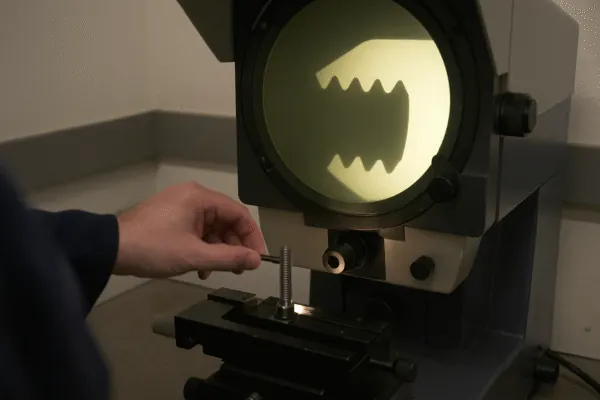
As a buyer, you should always ask how a potential supplier will verify your parts. Making a thread is one skill; proving it meets the standard is a different, more critical one.
Our Multi-Step Inspection Protocol
- First-Article Inspection: The very first part off the machine is brought to the lab for full dimensional analysis.
- Gauge Test: An inspector takes a calibrated thread gauge. The "Go" side must screw in smoothly; the "No-Go" side must not engage more than two turns.
- Optical Comparator: We project a 50x magnified silhouette of the thread, checking it against a precise overlay of the standard's profile to verify angle, root, and crest.
- In-Process Checks: This entire process is repeated at regular intervals to ensure consistency and catch any drift from tool wear.
What are the Risks of Mixing Different Thread Standards?
Your project might use components from different countries. Accidentally mixing metric and imperial fasteners can cause stripping, cross-threading, and catastrophic failure.
**The risks are huge, ranging from assembly delays to serious safety hazards. The consequences of component failure can be devastating, as tragic engineering failures have shown. This is why strict segregation and 100% verification are fundamental to our process.
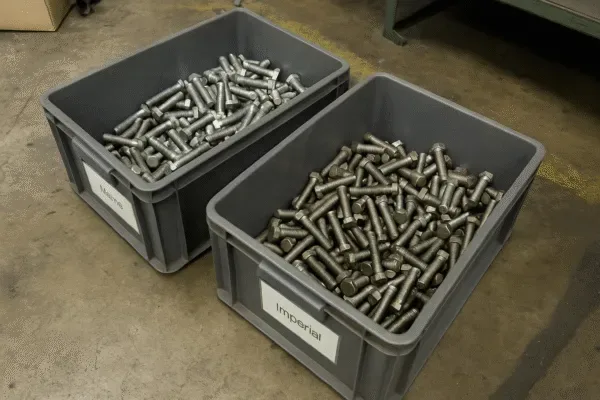
I remember a delivery case where a client's product was failing in the field. Their assembler had mistaken an M8 bolt for a 5/16" bolt. They are very close in diameter, but the pitches are completely different. The connection felt tight, but it was actually stripped. This kind of field failure can ruin a company's reputation and lead to warranty claims.
The Danger of a "Close Fit"
| Imperial Screw (Similar Diameter) | Metric Screw (Similar Diameter) | The Problem for the Buyer |
|---|---|---|
| 5/16"-18 UNC (7.938 mm dia.) | M8x1.25 (8.0 mm dia.) | Will cross-thread, causing assembly failure and rework costs. |
| 1/4"-20 UNC (6.35 mm dia.) | M6x1.0 (6.0 mm dia.) | Looks close, won't engage, stopping the production line. |
Our zero-mixing strategy prevents this by using segregated workstations, color-coded bins, and a final verification check before packaging, guaranteeing you receive exactly what you ordered.
How Do Different Thread Standards Impact Your Cost?
As a buyer, you need to know: does the choice between a standard UNC bolt or a fine-pitch metric one affect the final price?
Yes, the thread standard can influence cost, but usually less than material or tolerance. The key for a buyer to understand is that non-standard threads require custom tooling, and tighter tolerances require more inspection time. We can help you analyze your design to find cost-saving opportunities.
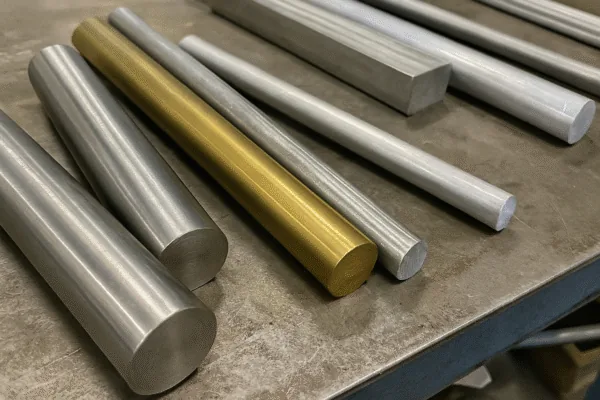
For a buyer like Kevin, every penny counts. The most cost-effective path is to use a common, standard thread whenever possible. To explore how we can optimize your designs for cost, you can review our CNC machining services1 and reach out to our team. Using a resource like MatWeb2 can also help you compare the base costs of different raw materials.
Frequently Asked Questions (FAQs)
Q1: Can you produce custom or non-standard threads? A: Yes. We have the capability to create custom thread profiles for legacy parts or special applications. This requires manufacturing custom cutting tools and special inspection gauges. It's a core part of our one-stop service to solve complex sourcing problems.
Q2: From a buyer's perspective, what is the real difference between UNC and UNF threads3? A: As defined by the ASME B1.1 standard, the choice impacts assembly and performance. Use UNC (Coarse) for faster assembly. Choose UNF (Fine) when you need higher tensile strength and better resistance to vibration, such as in automotive or aerospace components.
Q3: How do I read a standard thread callout like "M10 x 1.5 - 6g"? A: This ISO code tells you everything:
- M10: Metric thread, 10mm nominal diameter.
- x 1.5: The pitch is 1.5mm.
- - 6g: This is the tolerance class. As a buyer, you need to ensure this matches the internal thread class (e.g., "6H") of the mating part.
Q4: For a buyer, what does ISO 9001 certification4 really mean? A: It means predictability and accountability. ISO 9001 is a quality management system that mandates auditable processes for everything from contract review to calibration. It is your assurance that we produce all our parts, including our extensive screw selection, to a consistent, high standard.
Conclusion
Choosing a factory that masters global thread standards is vital. It means your drawings are understood, the right standards are applied, and your supply chain is safe from costly mix-ups.
<br>
→ Upload Your RFQ & Contact Prime Fabworks
<br>
Explore how CNC machining can enhance your design efficiency and reduce costs effectively. ↩
Discover how MatWeb can assist you in making informed decisions about material selection and cost. ↩
Understand the critical differences between UNC and UNF threads to make better assembly choices. ↩
Learn about the importance of ISO 9001 certification in ensuring consistent quality in manufacturing processes. ↩