
Are you tired of slow production and high costs in your metal part sourcing? Many partners struggle with slow throughput and rising unit expenses for their stamped components.
Progressive die stamping1 offers a powerful solution by combining multiple operations into a single setup. This method drastically cuts labor, machine time, and handling, leading to significant cost reductions and much faster delivery schedules for high-volume orders, a process that is standardized under quality systems like ISO 90012.
It is vital to understand these advanced manufacturing techniques1 to make smart sourcing choices2. Over my 30 years in this business, I've seen countless projects get bogged down by inefficient methods. Let's look closer at how this specific process delivers better results for your business needs, especially for high-demand items. My factory has been leveraging this since the early 2000s to serve clients like Siemens.
How Does The Progressive Die Process Actually Work?
Struggling to visualize how one machine does the work of five? This process can seem complex, but its core principle is simple and extremely efficient for production.
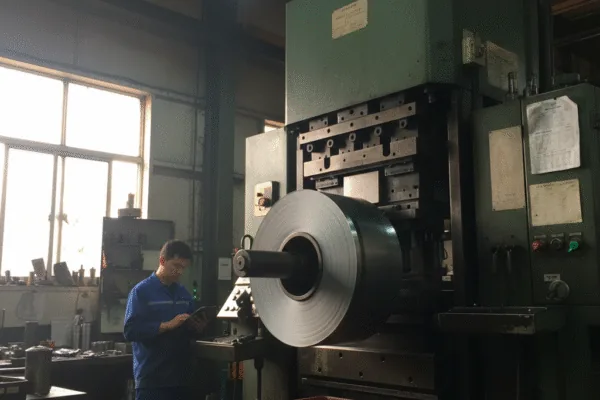
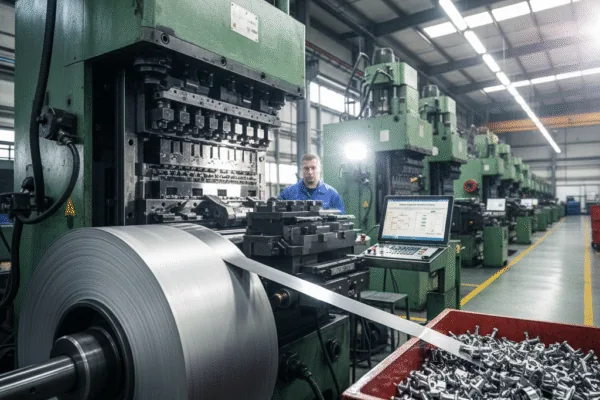
The progressive die process1 works by feeding a strip of raw material, usually a coil, through a sequence of stations in one large die. Each station performs a specific operation like punching, coining, or bending. The material advances from station to station with each stroke of the press. This automation is key; the die guides the material precisely at every step, as outlined in basic manufacturing principles2 on sources like Wikipedia. For instance, a part that previously required four separate dies and four workers now only needs one coil loaded. This multiplies output significantly.
This speed directly translates to a lower per-part cost, which is essential for projects involving our high-volume stamping parts.
| Material Type | Suitability for Progressive Die | Key Consideration | My Factory's Insight |
|---|---|---|---|
| Carbon Steel (Coil)1 | Excellent | Good balance of strength and formability | This is our standard, most cost-effective stock. |
| Stainless Steel | Good | Requires more die wear resistance due to hardness | We use hardened D2 steel inserts for a longer tool life. |
| Aluminum (Coil)2 | Very Good | Ideal for lightweight parts, excellent forming | Fast cycling is possible due to lower material strength. |
| Thick Plate Material | Poor | Progressive dies favor thinner, coiled stock | This is better suited for our single-hit presses. |
This process is ideal for products in high demand, where the initial cost of the complex tooling is quickly absorbed by the huge number of parts produced.
How Does Precision Stamping Maintain Tolerance Stability In Mass Production?
Worried that quality will drop after the first thousand parts? For buyers like me, consistency is everything, especially when a bad batch can ruin a whole product line.
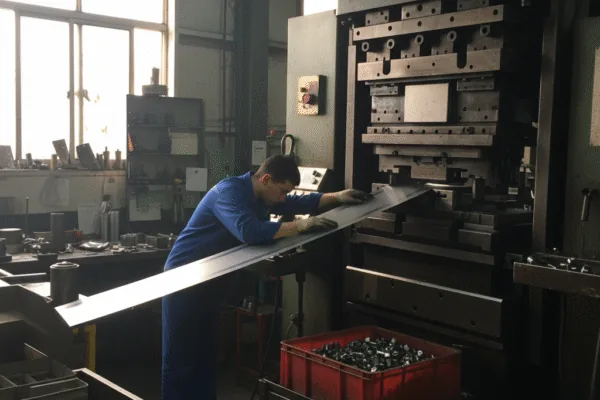
Maintaining tight tolerances is where the engineering of a progressive die truly stands out. All operations happen within one rigid die set on one press. This means the component’s position is fixed. There is no re-fixturing error between separate operations, a major source of tolerance drift. We design the die with precise guide pins and pilots to maintain near-perfect alignment. This inherent stability guarantees quality from the first part to the last, which is a core tenet of the ISO 9001 standard we are certified for. When my team approves a new die, we validate guide clearances to within microns. For a quality-sensitive buyer, this process minimizes rejects and protects your reputation. Our full PPAP (Production Part Approval Process) documentation confirms this stability before we ever ship.
For more details on our quality commitments, you can always reach out via our contact page.
How Can We Shorten The Lead Time From Tooling To First Part?
Are long tooling lead times causing you to miss your sales season? A delayed shipment is one of my biggest pain points, so we have optimized our process to be faster.
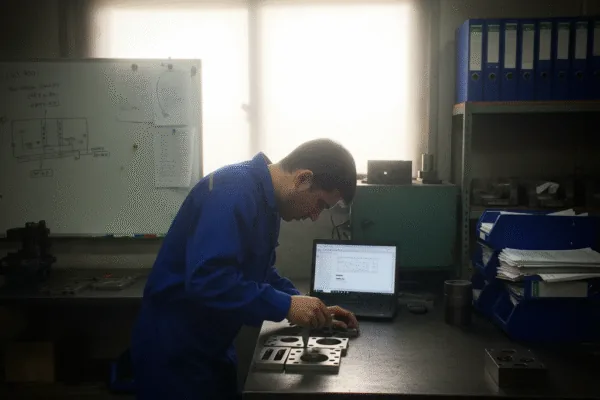
Shortening lead time starts long before the press runs. It begins with meticulous tooling design using CAD/CAM systems. We use simulation to perfect the material layout and avoid issues like spring-back. Investing in high-precision CNC machining1 for the die components upfront prevents costly rework later. Sourcing from an integrated factory like Prime Fabworks, which handles everything in-house, is much faster than using separate vendors. Once the die is built, we move to the First Article Inspection2 (FAI). We treat this as a critical path. A successful FAI, which leads to your PPAP approval, is our top priority. For urgent projects, our multiple production lines mean once a die is approved, it goes straight to work. This integrated approach dramatically cuts lead times, a key benefit when sourcing CNC parts or any custom component.
| Lead Time Stage | Standard Timeframe (Weeks) | How We Accelerate It | What a Buyer Should Focus On |
|---|---|---|---|
| Tool Design & Simulation | 2-3 | Concurrent engineering review with your team | Clear design verification and sign-off |
| Die Component Machining1 | 4-6 | Utilizing our dedicated, in-house CNC capacity | Validating raw material certifications |
| Die Assembly & Fit Check | 1 | Scheduling expert toolmakers for focused work | Internal quality checks before the press trial |
| First Article Inspection (FAI)2 | 1 | Pre-scheduling press time immediately after assembly | Fast review and formal approval of sample parts |
Where Do The Real Cost Savings Come From In Progressive Stamping?
Are the unit price quotes you receive confusing? Let me break down exactly where the savings happen, so you can see why this method is so cost-effective for large orders.
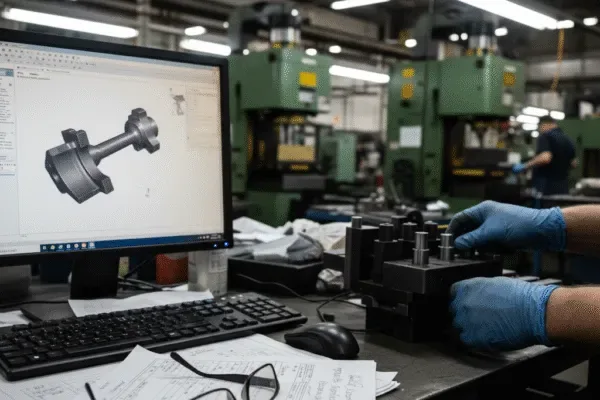
The main saving comes from a lower unit cost1 on high volumes. Consolidating a four-step manual process into one automatic cycle eliminates three workers' labor costs and the overhead of three extra machines. For an order of 100,000 pieces, this saving alone is huge. Scrap control is another powerful saving. A well-designed die nests parts tightly on the metal strip, so the only waste is the thin ribbon connecting them. This maximizes the yield from your expensive raw material. Finally, post-processing costs fall. Since the die performs complex bends and piercings, we reduce the need for secondary drilling or manual assembly. Fewer handling steps also mean less cosmetic damage, reducing rework.
Conclusion
Progressive dies combine steps into one fast cycle, drastically cutting your costs and delivery times.
Ready to optimize your component sourcing with industry-leading speed and verifiable quality?
Upload RFQ / Contact Prime Fabworks Today