
When deciding between manufacturing processes for metal fabrication, the cost-effectiveness question between stamping and laser cutting isn't straightforward. The answer depends heavily on your production volume, timeline, and specific requirements. Let's dive deep into the economics of both processes to help you make an informed decision.
The Volume Breakeven Point: Where Cost Dynamics Shift
The most critical factor determining cost-effectiveness is production volume. Laser cutting delivers 40% cost reduction with laser vs stamping for batches under 3,000 units by eliminating $15,000+ tooling costs, while stamping becomes increasingly cost-effective as volume scales up.
Small to Medium Production Runs (Under 3,000 Units)
For smaller production runs, laser cutting typically offers superior cost-effectiveness due to:
- No Tooling Costs: Laser cutting eliminates the need for expensive dies and punches
- Immediate Production: Parts can be produced within days rather than weeks
- Design Flexibility: Changes can be implemented without costly tooling modifications
- Higher Precision: Laser cutting achieves ±0.1mm precision compared to stamping's ±0.3mm tolerance
Laser cutting is often a cost-effective and time-saving alternative to stamping, particularly when rapid prototyping or small batch production is required.
High-Volume Production (Over 10,000 Units)
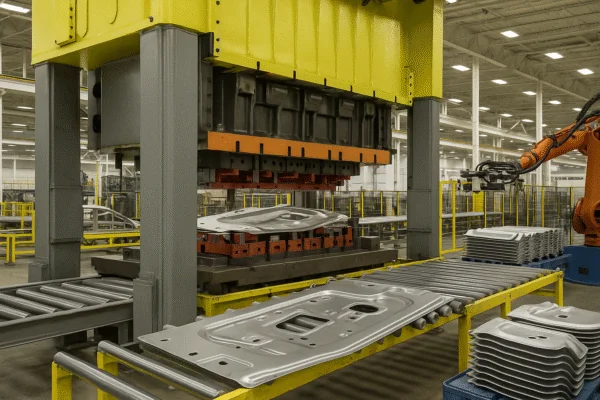
For large-scale manufacturing, stamping becomes more cost-effective because:
- Lower Per-Unit Costs: During production, stamping can produce products at a much faster rate than laser cutting resulting in a lower piece cost
- Die Longevity: A manufacturing facility can use a single die to stamp over one hundred thousand components before needing to replace the die
- Economies of Scale: The high upfront tooling cost gets distributed across many units
Initial Investment and Lead Time Considerations
Stamping Setup Costs and Timeline
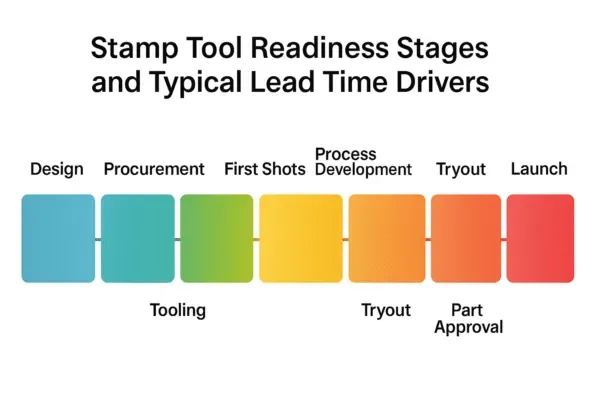
Because of the need to engineer & manufacture a die, stamping can typically delay production anywhere from 5–16 weeks or more at the onset. The initial investment includes:
- Die design and manufacturing ($15,000–$50,000+)
- Press setup and calibration
- Quality testing and validation
- Potential design iterations
Laser Cutting Setup
Laser cutting offers immediate production capability with minimal setup:
- Program creation and testing (hours to days)
- Material optimization and nesting
- First article inspection
- No tooling investment required
Per-Unit Cost Analysis
When Laser Cutting Wins on Cost
When looking solely at the per piece cost of a final product, laser cutting is always more expensive than stamping in terms of direct processing costs. However, when factoring in total project costs including tooling, laser cutting wins for:
- Prototype and development phases
- Small batch production
- Complex geometries requiring expensive tooling
- Projects with tight deadlines
When Stamping Dominates
Metal stamping can be cost-effective for high-production volumes, with a higher upfront cost that decreases as the number of required units increases. Stamping becomes more economical when:
- Production volumes exceed 10,000–50,000 units
- Simple to moderate complexity parts
- Long-term production commitments
- Consistent demand patterns
Design Complexity Impact on Costs
Laser Cutting Advantages for Complex Parts
Metal stamping is harder with more complex pieces. Complicated shapes with complex cutting geometry will require a more expensive tool, making laser cutting more cost-effective for:
- Intricate geometries
- Parts with many small features
- Designs requiring frequent modifications
- Prototypes and custom applications
Material Considerations
Cutting harder metals will wear the tooling out faster, while for the laser cutter, hardness will not matter. This makes laser cutting more cost-effective for:
- Exotic or hard materials
- Varying material thicknesses
- Mixed material production runs
Quality and Secondary Operations
Precision and Finish Quality
Unlike a stamping machine or press brake, a laser cutting machine does not rely on mechanical force to penetrate metal. This eliminates many of the microscopic fractures and stress marks that might weaken a piece of sheet metal.
Laser cutting often provides:
- Superior edge quality
- Minimal secondary operations
- Better dimensional accuracy
- Consistent quality across production runs
Secondary Processing Costs
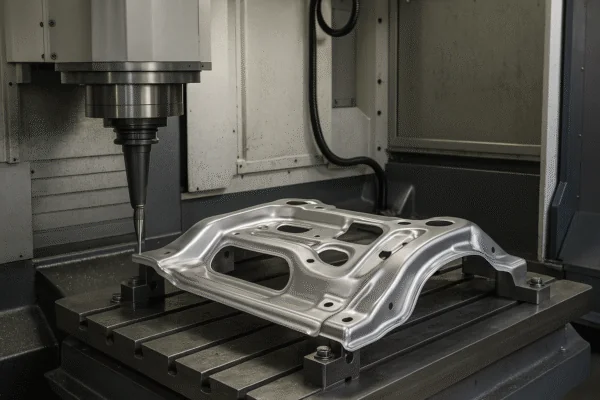
Stamping may require additional operations that impact total cost:
- Deburring processes
- Secondary machining for precise features
- Quality control and inspection
- Potential rework for dimensional issues
Making the Right Choice for Your Project
Choose Laser Cutting When:
- Production volume is under 3,000–5,000 units
- Quick turnaround is essential
- Design changes are likely
- High precision is required
- Complex geometries are involved
- Working with hard or exotic materials
Choose Stamping When:
- Production volume exceeds 10,000 units annually
- Long-term production commitment exists
- Simple to moderate part complexity
- Lowest per-unit cost is critical
- Consistent demand patterns are established
The Hybrid Approach: Best of Both Worlds
Many manufacturers are adopting hybrid strategies:
- Use laser cutting for prototyping and initial production
- Transition to stamping when volumes justify tooling investment
- Employ laser cutting for complex features combined with stamped blanks
- Utilize laser cutting for seasonal or variable demand products
Cost-Effectiveness Calculator Framework
To determine the most cost-effective approach for your specific application, consider:
- Total Project Volume: Annual and lifetime production quantities
- Tooling Investment: Dies, punches, and setup costs vs. programming time
- Timeline Requirements: Development speed vs. production efficiency
- Quality Standards: Precision requirements and acceptable tolerances
- Design Stability: Likelihood of changes throughout product lifecycle
- Material Considerations: Type, thickness, and hardness of materials
Conclusion: Volume is King, But Context Matters
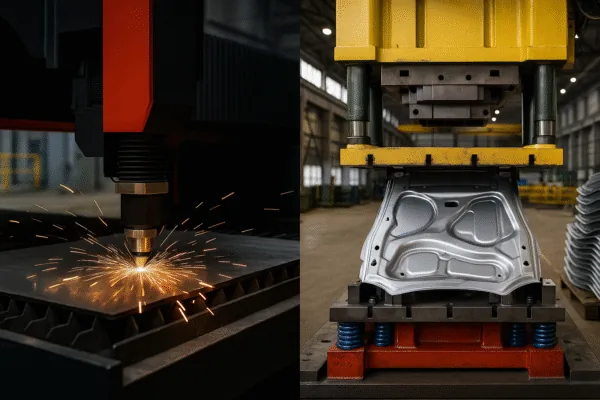
While production volume remains the primary determining factor, the most cost-effective choice between stamping and laser cutting depends on your specific application context. For small batches or prototypes needing high precision, laser cutting is better. For large production runs where per-unit cost is critical, stamping is the superior choice.
The key is performing a total cost of ownership analysis that includes not just the per-unit processing cost, but also tooling investments, lead times, quality requirements, and design flexibility needs. In today's dynamic manufacturing environment, the most cost-effective approach often involves leveraging both technologies strategically throughout the product lifecycle.
Understanding these cost dynamics will help you make informed decisions that optimize both your budget and production timeline, ultimately delivering better value to your customers while maintaining competitive advantage in the marketplace.