
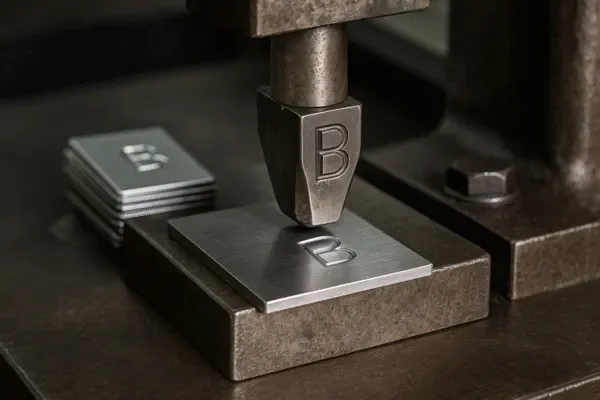
Poor mark clarity, chipped edges, and missed deadlines cost money. You need a stamp spec that fits your material, volumes, and safety limits.
Match stamp steel and hardness to your workpiece, size characters for legibility, choose hand vs. press based on volume and repeatability, and estimate force from material strength and thickness. Specify shank, font, depth, and fixtures. Validate with a sample on your actual alloy and finish.
I’ll show how I size stamps, when hand stamps make sense, and which metals stamp easiest—so you can order confidently and avoid rework.
Do we manufacture both large and small stamps?
Small characters can chip; large faces can bounce and blur. Getting the size right prevents scrap.
Small hand stamps (1–6 mm characters) suit low volumes and field work. Large press dies (20–300 mm logos, multi-line) suit repeatable in-plant marks. Typical stamp steels are A2, D2, or S7, hardened ~HRC 58–62. Use fixtures for squareness, add draft and relief for clean impressions.
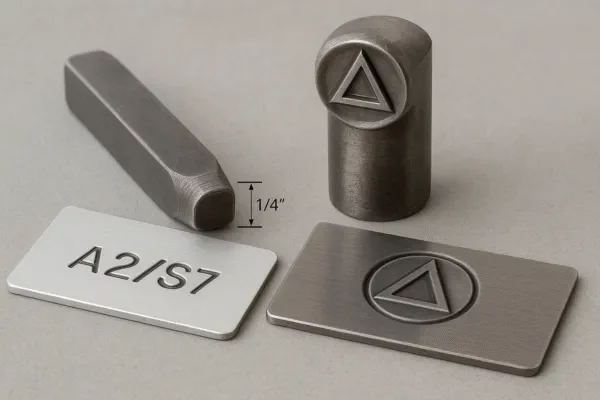
I build both small and large stamps in-house at Prime (China), an ISO-certified factory with 10 production lines. I pick steel by use. For handheld impact, S7’s toughness resists chipping. For high-wear press dies, D2’s carbide content extends life on abrasive stainless and coated sheet. A2 is a versatile middle ground for general-purpose marks. I heat treat to ~HRC 58–62, then temper for stability. For delicate logos, I combine CNC, EDM, and fiber laser engraving to preserve edge fidelity.
Size drives geometry. As a rule of thumb, I target mark depth at 10–20% of character height on ductile metals. I add 1–3° draft to ease release and include relief pockets to carry displaced material. On curved or thin parts, I design contoured faces or sacrificial pads to avoid double hits and oil-canning. For wide logos (>100 mm), I may split the die into segments: this minimizes heat-treat distortion, reduces press tonnage, and lets you replace only worn sections.
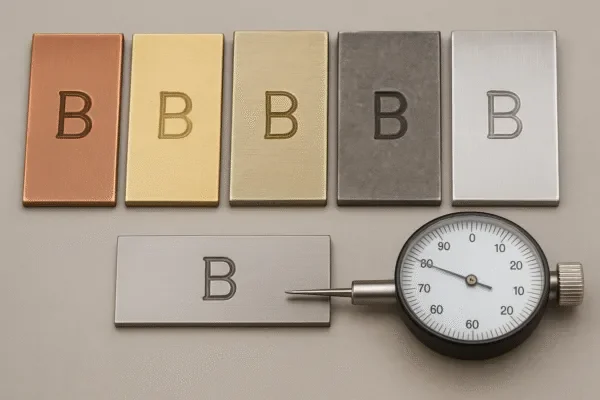
I always propose a first-article mark on your actual material and finish. Coatings change contrast. Anodized aluminum needs extra depth for readability. Painted steel benefits from post-mark paint fill. I ship stamps with tip protectors, VCI wrap, and foam nests to prevent edge dings. If you need metrology, I can include hardness readings and a CMM depth map at sample points.
References: Tool steel choices and behavior are covered well in standard texts and data sheets; for hardness testing methods, see ASTM E18 (Rockwell) and ASTM E10 (Brinell).
Practical checkpoints buyers should verify
- Character/logo height × depth, font, and vector artwork.
- Shank size, overall length, and striking method (hand, arbor press, hydraulic).
- Workpiece alloy, thickness, hardness/temper, and final surface finish or coating.
Quality & packaging notes buyers care about
- Request heat-treat certificate and hardness at the working end.
- Approve a test mark on your actual alloy; keep photos with scale and depth data.
- Use VCI + foam + corner guards; add labeled tip caps for fine detail.
Cost & Lead Time Comparison
| Factor | Option A | Option B | What it means for cost/lead time |
|---|---|---|---|
| Material/Grade | A2 tool steel | D2 tool steel | D2 wears longer on stainless; +1–2 days heat-treat/cryogenic cycle. |
| Strength/Hardness | HRC 58–60 | HRC 60–62 | Higher hardness resists wear but needs larger edge radii to avoid chipping. |
| Corrosion Resistance | Oil coat | Nitrided + oil | Nitriding improves wear/corrosion; typically adds 2–3 days. |
| Tolerance Feasibility | ±0.10 mm depth | ±0.05 mm depth | Tighter control requires EDM finishing and more inspection. |
| Surface Finish | Ra 1.6–3.2 µm | Ra 0.8 µm polished | Polished faces improve legibility on soft alloys. |
| Testing/Reports | Photo FAI | CMM depth map + hardness | Higher confidence for audited or automotive programs. |
Upload your drawing and I’ll confirm size, steel, and heat treatment, then return a 24-hour DFM note and quote.
Not sure if a custom steel hand stamp is right for your project?
Low volumes love flexibility; high volumes need fixtures and repeatability.
Choose a custom hand stamp for low-volume, mobile, or hard-to-fixture parts. It excels on ductile metals (aluminum, copper, brass, mild steel). For >500 identical marks or tight tolerances, use a press die, dot-peen, laser, or roll marking. Validate on your actual alloy and surface finish before ordering.
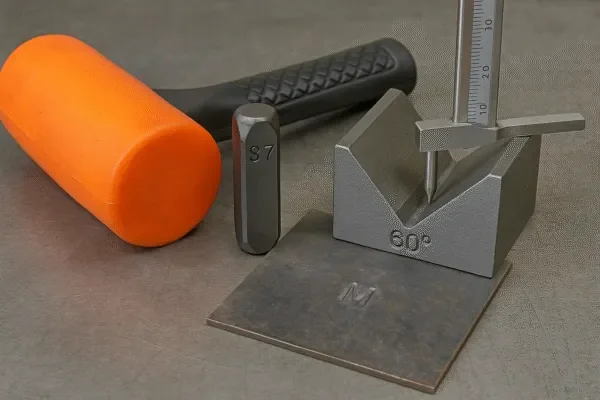
What metal is easiest to stamp, and how hard is it to stamp metal?
Soft, ductile metals mark cleanly; hard, springy metals fight back.
Easiest: annealed copper (C110), cartridge brass (C260), and soft/temper aluminum (1100-O, 6061-T4).
Medium: low-carbon steel (A36, 1018).
Harder: austenitic stainless (304/316), especially work-hardened.
Required force roughly follows shear strength and thickness; a common guide is perimeter × thickness × shear strength. Always test on your actual temper.
Conclusion
Choose stamp size, steel, and method around alloy, hardness, and volumes—validate on your material—then upload drawings for 24-hour DFM advice and quote.